

The best League of Legends coaching tools to progress in 2026
Most players who climb don't use one tool. They use two or three, each for a different job: one to prepare before a game, one to learn from it after, and something to study the game between sessions. The hard part is knowing which job each tool actually does, because most of them call themselves a "coach".
This guide sorts the main League of Legends coaching tools by what they help you fix, says what each one is best at and where it stops, and ends with a simple routine that combines them.
A disclosure first: we make postgame.lol, the first tool on this list. We put it first because it does the job we think matters most for climbing, and we've tried to be fair about everything else, including where other tools do better than ours.
The short answer
| Tool | Best for | When you use it | Price |
|---|---|---|---|
| postgame.lol | Finding the mistakes that lost you a game | After each game | Free reviews each month, Pro for unlimited |
| Mobalytics | Seeing your strengths and weaknesses across many games | Between sessions | Free, with a paid tier |
| A human coach (Metafy and others) | Personal feedback on how you think and play | Every few weeks | Paid per session |
| Skill Capped | Learning concepts from high-elo players | Between sessions | Subscription |
| Porofessor | Knowing who you're about to play against | Loading screen | Free, with a paid tier |
| Blitz | Builds, runes and timers without leaving the game | Champion select and in game | Free, with a paid tier |
| OP.GG, U.GG, LoLalytics | Builds, matchups and tier lists | Before a game | Free |
| Your own replays | Watching yourself play, with no help | After a game, if you have time | Free |
What actually makes you climb
You climb when you stop making the mistakes that cost you games. That sounds obvious, but most tools help with something else: they make you better informed (what to build, who's strong this patch, what your opponent plays) without telling you what went wrong in your own game.
Being informed is worth something, and the right build or a good champion pick wins you a few percent. But the games you lose at your rank are mostly lost to the same handful of habits, repeated: dying alone just before Dragon, walking into a lane while the enemy jungler is unseen, sitting on 1,500 gold for two minutes. A tool that shows you those habits, game after game, is the one that moves your rank. The rest make each game a little easier.
So for each tool below, the question is: does it help you play better, or help you know more?
1. postgame.lol: find the mistakes that lost you the game
postgame.lol reviews your replay the way a coach watching the game with you would. It reads the replay file itself, so it knows where every champion was, second by second, what each team could see, and what everyone had in their bag. From that it finds the moments that cost you the game, explains why each one was a mistake, shows it on the map and in a clip from your own game, and ends with the one habit to work on in your next game.
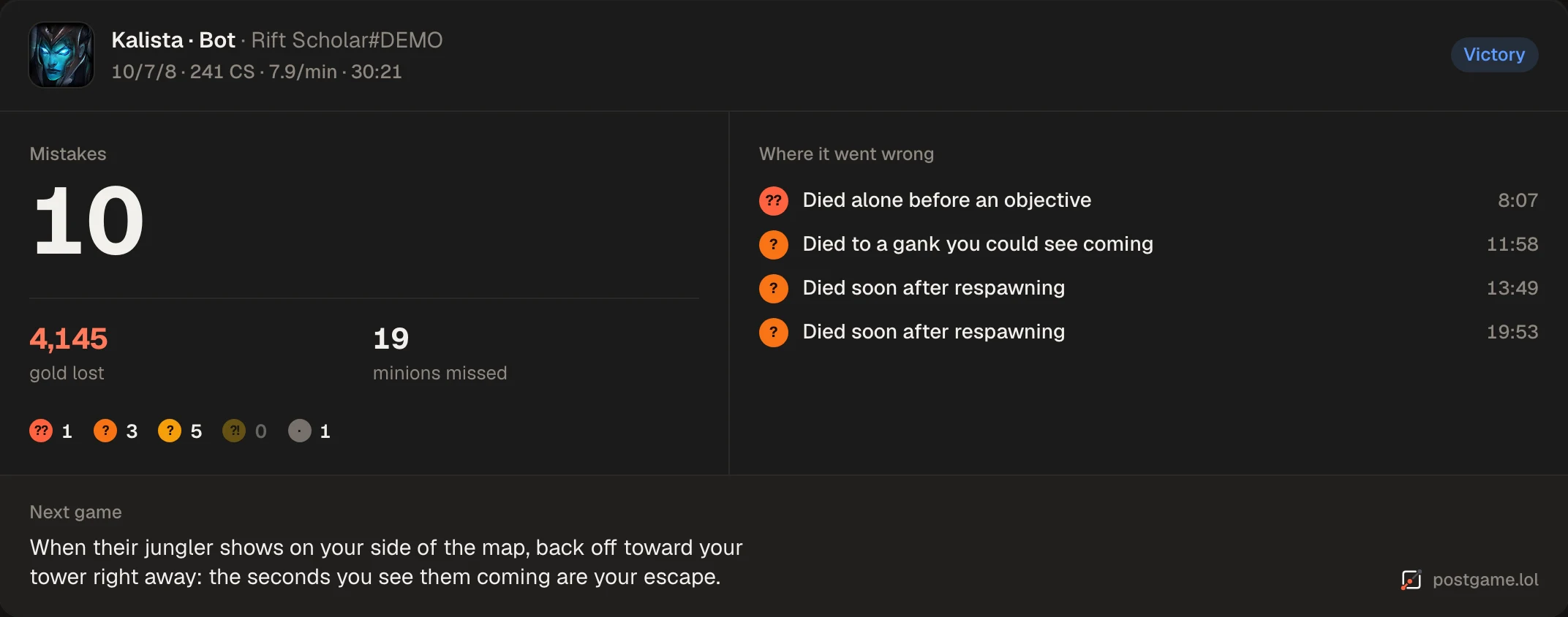 The start of a review: what the game cost you, the mistakes that hurt most, and the one thing to change next game.
It checks 38 kinds of mistakes across the parts of the game that decide most solo queue games: the jungle (falling levels behind the enemy jungler, a slow first clear, Smite fights lost), waves (minions left under your tower, a cannon missed, recalling without pushing), vision (no ward before the first gank, a control ward kept in the bag), objectives (dying alone before Dragon, recalling into a fight, kills not turned into a tower), and items (no anti-heal against healers, gold kept instead of spent).
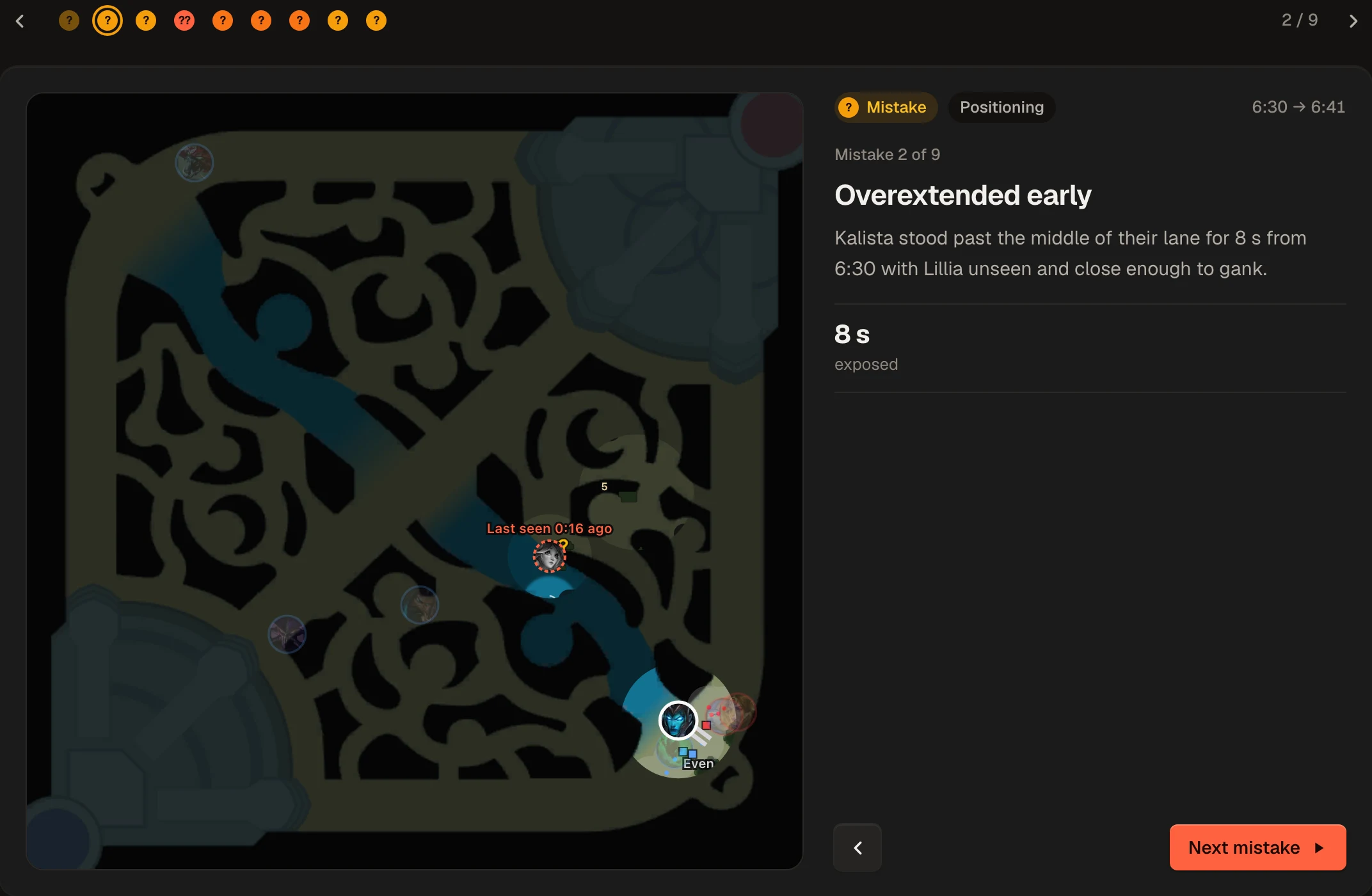 Each mistake on the map, with what you couldn't see while playing: here, the enemy jungler last seen 16 seconds before, close enough to gank.
Why it helps you climb:
- You learn from the game while it's fresh, in under a minute, instead of spending 30 minutes scrubbing through a replay.
- It's specific: not "your vision score is low" but "at 6:40 you walked into the river with no ward while their jungler was last seen on your side".
- It tells you one thing to fix next game, not twenty.
- With Pro, it shows the mistakes you keep making across all your games, which is where your rank actually is.
- The free desktop app gets the replay from the League client for you and can review every solo queue game as soon as it ends, so you never have to remember.
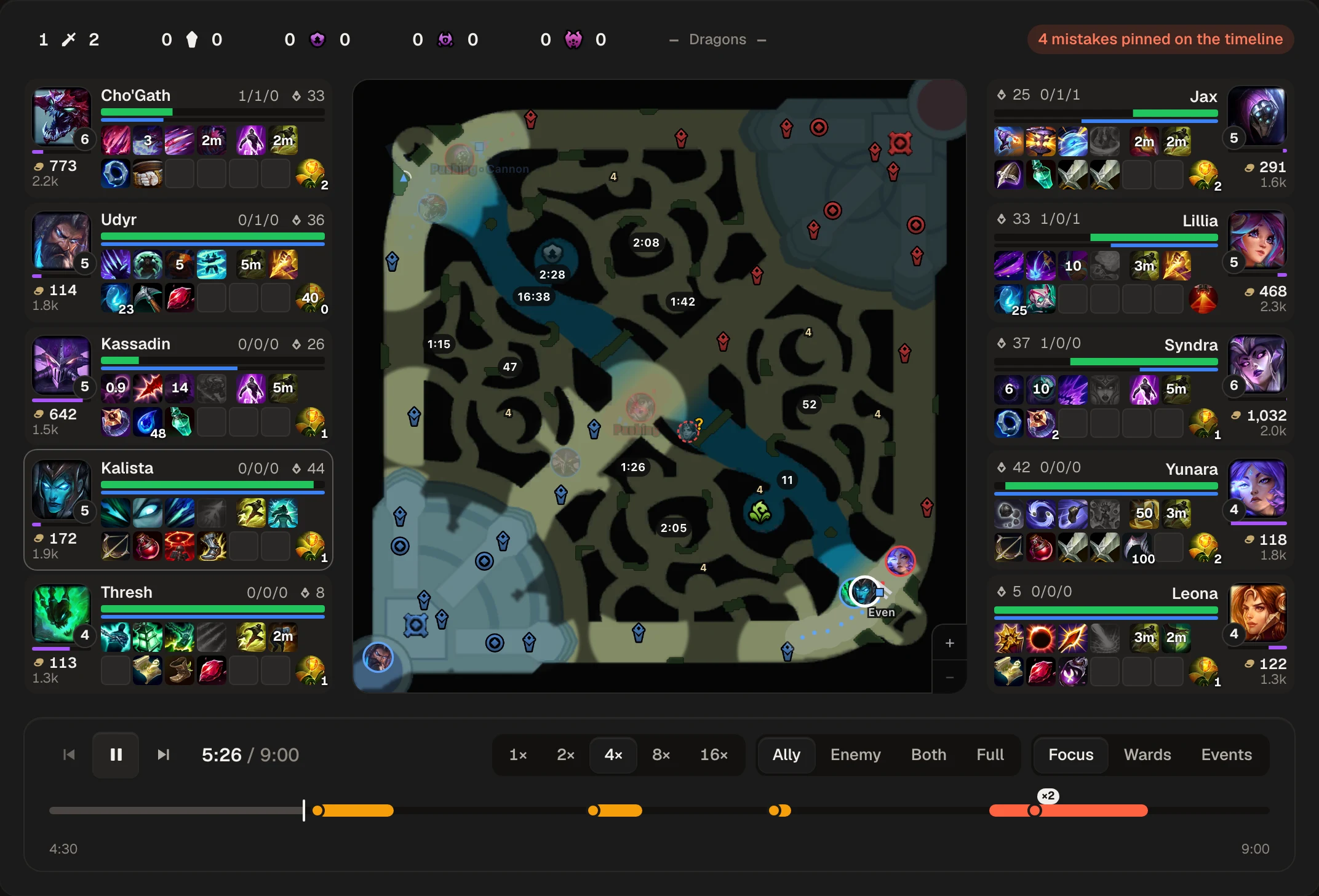 Watch the game back with both teams' items and cooldowns, what your team could see, and every mistake pinned on the timeline.
Where it stops:
- It reviews games you've played. It doesn't help in champion select or during the game, and it doesn't suggest builds.
- It finds the mistakes it knows how to recognize. A human coach will still catch things it doesn't, like how you trade in lane or why you made a call.
- Summoner's Rift only, and the League client only downloads replays from the current patch, so review your games before the next one lands.
Price: a few free reviews every month, no card needed. Pro, for unlimited reviews and your mistakes across all your games, is €1.99 a month during the beta.
Best for: any player who wants to know why they lost, and what to do differently, after every game.
2. Mobalytics: your strengths and weaknesses over many games
Mobalytics is one of the oldest and best-known League companion apps. Its centerpiece is the Gamer Performance Index (GPI), which turns your recent matches into scores across areas like farming, fighting, vision, aggression and consistency, and compares them to players at your rank. Around that it has builds, tier lists, a desktop app with in-game overlays, and guides.
What it does well: it gives you a clear picture of your profile across many games, which is a good starting point if you have no idea what your weak side is. The builds and guides are solid and up to date.
Where it stops: GPI is built from match statistics, the numbers Riot records at the end of each game and once a minute during it. It can tell you that your vision is below average for your rank; it can't show you the ward you didn't place before the gank that killed you. It points at an area, and you still have to find the moments yourself.
Best for: a broad picture of where you stand, plus builds and guides in one place.
3. A human coach: feedback on how you think
Coaching marketplaces like Metafy let you book a session with a high-elo player or a professional coach, who reviews your games with you, live or from a recording. Many streamers and ex-pros also coach on their own.
What it does well: nothing beats a good coach at understanding why you made a decision. They can ask what you were thinking, catch mechanical and laning habits, and build a plan around your champion pool and your role. If you want to go from Diamond to Master, a human coach is close to essential.
Where it stops: it's the most expensive option by far, and a session covers one or two games. A coach is only as good as their teaching, and high rank doesn't mean good teaching, so read reviews and try a short session first. Between sessions, you're on your own.
Best for: players ready to invest in a few sessions, ideally with a tool that keeps reviewing every game in between.
4. Skill Capped: learn the concepts
Skill Capped makes video courses and guides with high-elo players: how to play each role, wave management, jungle pathing, champion guides, and the fundamentals that separate ranks.
What it does well: it teaches you the ideas you don't know yet. Short, focused videos, a big library, and explanations from players who understand the game at the highest level.
Where it stops: it's general. Watching a video on wave management doesn't tell you that you lost three waves under your tower last game. Knowing a concept and applying it under pressure are two different skills.
Best for: learning what to do, paired with a review tool that shows whether you're doing it.
5. Porofessor: know who you're playing against
Porofessor, from the team behind League of Graphs, shows up in the loading screen with everything about the nine other players: their rank, their recent games on the champion they picked, whether they're a one-trick or on a losing streak, and their usual habits. It also has an in-game overlay.
What it does well: it's the fastest way to know who to play around and who to punish before the game starts. Knowing the enemy jungler is on their first game of the champion changes how you play the first five minutes.
Where it stops: it's preparation, not improvement. It tells you about others, not about your own mistakes.
Best for: the loading screen.
6. Blitz: builds and timers without leaving the game
Blitz is a desktop app that imports runes and item builds in champion select and adds overlays during the game, such as jungle camp timers and build suggestions.
What it does well: it saves you time and clicks, and gives newer players sensible builds for any champion without having to look them up.
Where it stops: like the stats sites, it makes you better informed, not better. Some players also find overlays distracting.
Best for: players who want good builds automatically.
7. OP.GG, U.GG and LoLalytics: builds, matchups and tier lists
These are the stats sites nearly every player has open at some point. OP.GG is the classic for looking up a player's profile and match history. U.GG is quick and clean for builds and runes. LoLalytics goes deepest into the numbers: win rates for each item, rune and matchup, by rank.
What they do well: they tell you what works this patch, with data from millions of games. For picking a champion or learning a matchup, they're the best free resource there is.
Where they stop: they're about champions, not about you. Your win rate on a champion tells you that you lose; it doesn't tell you why.
Best for: builds, matchups and picking what to play.
8. Your own replays: free, but slow
The League client lets you download and watch the replay of any game from the current patch. Watching yourself is how many good players got good, and it costs nothing.
What it does well: it's the full picture. You can watch every fight from any angle, at any speed.
Where it stops: a game is 30 minutes, and most players don't know what to look for, so they watch the teamfights and miss the mistakes that set them up: the recall a minute too late, the ward never placed. Few players keep it up for more than a few games.
Best for: players with time, who know what they're looking for. A review tool that points you to the moments that matter makes it much faster: watch those moments, not the whole game.
How to combine them
You don't need all of these. A routine that works for most players looks like this:
- Before the game: a stats site (U.GG, LoLalytics) or Blitz for your build, Porofessor in the loading screen.
- After every game: a review of what went wrong, while you remember the game. This is the step most players skip, and it's the one that makes them climb. postgame.lol does it in under a minute, or automatically with the desktop app.
- Every week: look at the mistakes you keep making across your games and pick one to fix. Watch a guide on it (Skill Capped, or a free one on YouTube) so you know what to do instead.
- When you plateau: a session or two with a human coach, bringing the games and the habits your review tool found.
Questions
Are these tools allowed by Riot?
The well-known tools on this list work with Riot's public API and data that Riot makes available, within its developer policies. postgame.lol only reads replay files, and the desktop app talks to the League client through its own local interface, the one it uses to download replays; it never touches the game or Vanguard. Stay away from anything that reads the game's memory or shows information the game hides from you, like enemy cooldowns you couldn't see.
Do I need to pay for a coaching tool?
No. You can climb a long way with free tools: free reviews on postgame.lol, a stats site, free guides, and your own replays. Paying makes sense when you play a lot (unlimited reviews, the patterns across all your games) or when you want a human to work with you.
Which tool is best for a beginner?
Start with a stats site for builds, so you're not losing games to your items, and a review after your games so you learn the basics of waves, vision and objectives from your own mistakes. Add the rest when you need it.